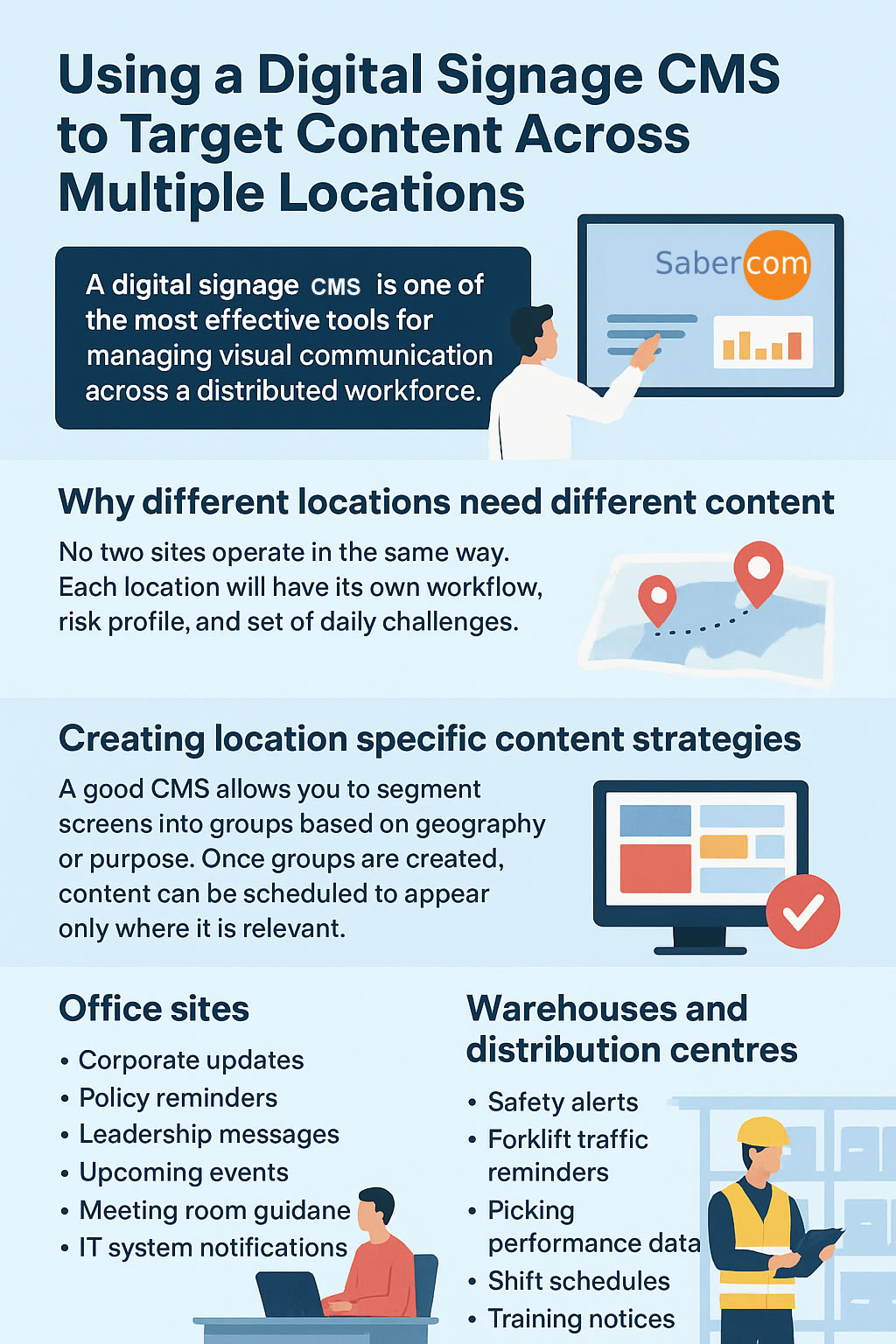
A digital signage CMS is one of the most effective tools for managing visual communication across a distributed workforce. Whether you operate a handful of local offices or a large network of industrial or retail sites, a centralised platform allows you to deliver the right information to employees in the right place at the right time. The true strength of a CMS lies in its ability to target content to specific screens or groups of screens. This ensures that every location receives material that reflects its activity, priorities, and operational needs.
Why different locations need different content
No two sites operate in the same way. Even within a single organisation, each location will often have its own workflow, risk profile, and set of daily challenges. Because of this, the information that matters to one team may be irrelevant to another. A warehouse may need regular safety reminders and live logistics data. A head office might prioritise internal announcements and HR updates. A manufacturing facility may require real time production metrics, machine status information, and maintenance alerts.
Using a digital signage CMS, you can create playlists that suit each environment. This avoids information overload and ensures that every screen remains useful rather than becoming visual noise that employees start to ignore.
Creating location specific content strategies
A good CMS allows you to segment screens into groups based on geography or purpose. For example, all screens in the lobby areas across all buildings can be grouped together, while screens in the engineering zones can be grouped in a different way. Once groups are created, content can be scheduled to appear only where it is relevant.
Scheduling and day parting for precise control
Scheduling is one of the most powerful features of a digital signage CMS. Instead of setting content to play continuously, you can choose exactly when each message appears. This allows you to match content to operational rhythms. For instance, health and safety reminders can be set to appear at shift change times, while performance updates may be better suited to mid shift periods when staff are more settled into their tasks.
Day parting goes a step further by dividing the day into time blocks. You can then assign different playlists to each block. Office sites may benefit from morning messages that highlight meeting schedules and IT updates, followed by afternoon content that focuses on HR reminders or wellbeing messages. In environments such as warehouses or retail sites where activity levels fluctuate throughout the day, day parting ensures that each team sees the information that is most relevant to their time on shift.
Examples of targeted content by location
Office sites
Provide internal communications with Corporate updates, policy reminders, leadership messages, upcoming events, meeting room guidance, and IT system notifications.
Warehouses and distribution centres
Safety alerts, forklift traffic reminders, picking performance data, shift schedules, and training notices.
Manufacturing facilities
Display production targets, equipment uptime data, maintenance schedules, process instructions, and safety KPIs using digital signage for manufacturing
Retail locations
Customer service tips, product launch information, promotional schedules, and stock alerts.
Benefits of location targeted and time targeted digital signage
When content matches the needs of each site and appears at the right moment, employees pay more attention. They trust the information and see it as relevant to their job. This leads to better communication outcomes and improved operational awareness.
Targeted scheduling also reduces the burden on internal communication teams. Instead of manually changing content for different shifts or regional requirements, you can automate delivery so that the correct material is shown at the correct time and place.
Another advantage is that a CMS allows you to update screens instantly. If a specific site needs time sensitive information such as weather warnings or urgent safety instructions, you can deploy it immediately to the affected location without interrupting screens elsewhere.
Building a future proof communication system
As organisations grow, communication challenges become more complex. A digital signage CMS gives you flexibility and scalability. You can add new sites, adjust content groups, introduce new schedules, and adapt your strategy without replacing hardware or redesigning processes.
By combining location-based targeting, scheduling, and day parting, you can build a communication system that delivers clear and consistent information, supports staff, strengthens safety behaviour, and improves overall engagement.
Final thoughts
A digital signage CMS gives organisations a practical and scalable way to communicate with clarity across every site. By tailoring content to local needs, scheduling messages for maximum impact, and using day parting to match the flow of each working day, you can turn every screen into a valuable communication tool. If you want to improve employee engagement, strengthen safety culture, and deliver information that truly supports your teams, now is the perfect time to explore how a modern CMS can transform your approach. Get in touch to find out how to get started.
